
In the architecture world, where ideas often begin on paper, Midjourney introduces an exciting dynamic. Its capabilities, if harnessed correctly, can revolutionise how architects conceive, iterate, and communicate designs. However, the key to getting the most out of Midjourney lies in creating effective prompts that truly capture your vision.
In this blog post, we’ll delve into the art of crafting prompts for Midjourney that lead to the generation of mesmerising architectural designs. We will break down the importance of language, explore various styles, delve into the influence of famous architects, and most importantly, provide real-world examples to inspire you.
By the end, you will not only be familiar with the usage of Midjourney but will also know how to articulate your architectural thoughts into structured prompts that this intelligent tool can understand.
Get ready to take a step into the future of architecture design, where AI bridges the gap between your creative thoughts and reality. Welcome to a journey that is only limited by your imagination.
Terminology for your Midjourney architecture prompts
As we dive into the expansive world of architectural design through Midjourney AI, it’s crucial to be equipped with the right vocabulary. The language of architecture is rich and layered; it encompasses terms that describe everything from structural elements to aesthetic styles, from the scale of a building to the mood it creates.
These terms are essential for translating your ideas into a language that Midjourney understands. Integrating specific architectural terms in your prompts can help guide the AI, refining its output to align with your envisioned designs.
Here is a comprehensive list of architectural terminologies, each one being a potential ingredient for crafting precise and effective prompts in Midjourney:
- Facade: The exterior face of a building, often the main front.
- Arch: A curved structure that supports weight above an opening.
- Column: A vertical structural element that transmits the weight of the structure above to other structural elements below.
- Patio: An outdoor space generally used for dining or recreation.
- Atrium: A large open space located within a building.
- Dome: A rounded vault forming the roof of a building or structure.
- Buttress: A structure built against or projecting from a wall which serves to support or reinforce the wall.
- Cantilever: A long projecting beam or girder fixed at only one end.
- Balustrade: A railing supported by balusters, especially an ornamental parapet on a balcony, bridge, or terrace.
- Mezzanine: A low storey between two others in a building, typically between the ground and first floors.
- Pergola: A structure usually consisting of parallel colonnades supporting an open roof of girders and cross rafters.
- Gable: The part of a wall that encloses the end of a pitched roof.
- Eaves: The part of a roof that meets or overhangs the walls of a building.
- Lattice: A structure consisting of strips of wood or metal crossed and fastened together with square or diamond-shaped spaces left between, used typically as a screen or fence or as a support for climbing plants.
- Portico: A structure consisting of a roof supported by columns at regular intervals, typically attached as a porch to a building.
- Frieze: A broad horizontal band of sculpted or painted decoration, especially on a wall near the ceiling.
- Mullion: A vertical bar between the panes of glass in a window.
- Pilaster: A rectangular column, especially one projecting from a wall.
- Vestibule: An antechamber, hall, or lobby next to the outer door of a building.
- Parapet: A low protective wall along the edge of a roof, bridge, or balcony.
Mastering these terminologies will allow you to harness Midjourney’s potential fully, creating detailed and accurate architectural designs with nothing more than a sentence or two. Enjoy the process of blending language with design, and watch your architectural dreams take shape.
Prompt examples using terminology
/imagine: An airy modernist library with tall glass walls allowing natural light to stream onto the wooden bookshelves. At the centre of the space is an open atrium, adorned with a large green wall, providing a visual connection to nature.

/imagine: A grand Victorian-style mansion with an intricate facade. It features a prominent portico supported by Corinthian columns, a round tower with a dome, and a spacious balcony with a detailed balustrade.

/imagine: A minimalist sustainable house nestled in a forest, featuring a green roof blending into the surroundings. Large glass walls reveal an open layout interior with a mezzanine floor, while a wooden patio extends into the lush greenery.

Styles for your Midjourney architecture prompts
Architecture is as varied as the cultures and times it springs from, each style expressing unique aesthetic tastes, structural innovations, and societal needs. Understanding different architectural styles is not only key to appreciating the rich tapestry of human history but also serves as a valuable tool in guiding the design output of Midjourney.
By integrating these styles into your prompts, you can instruct Midjourney to create images that capture the essence of these historical periods or blend elements from different eras for a fresh, unique design.
Here is a list of some of the most significant architectural styles that have marked their imprint on the canvas of human civilisation:
- Classical: Rooted in the traditions of Greek and Roman architecture, the classical style features symmetry, proportion, and columns.
- Gothic: Renowned for its soaring cathedrals, Gothic architecture is characterized by pointed arches, ribbed vaults, and flying buttresses.
- Renaissance: A revival of classical style, Renaissance architecture is known for its symmetry, proportion, and the regularity of parts as they are demonstrated in the architecture of classical antiquity and in particular, ancient Roman architecture.
- Baroque: An evolution of Renaissance design, Baroque architecture is defined by dramatic light, lavish ornamentation, and curving forms.
- Neoclassical: A revival of classical architecture, the Neoclassical style features grandeur, simplicity, and elegance.
- Victorian: Named after Queen Victoria, Victorian architecture is known for its intricate details, vibrant colors, and decorative excess.
- Modernism: A rejection of ornament, Modernist architecture emphasizes function and features minimalism and the use of modern materials like steel, glass, and concrete.
- Postmodern: A response to the austerity of Modernism, Postmodern architecture reintroduces color, ornament, and playful forms.
- Deconstructivism: Characterized by fragmentation, Deconstructivist architecture distorts and dislocates traditional architectural elements.
- Sustainable/Green Architecture: A modern style focused on energy efficiency, sustainability, and a direct relationship with the natural environment.
Incorporating these styles into your Midjourney prompts can take your architectural designs on a journey through time and space, bringing forth designs that resonate with the mood and character of these distinctive styles.
Prompt examples using styles
/imagine: a bustling city skyline at dusk, dominated by towering Modernist skyscrapers of steel and g lass, interspersed with vibrant Postmodern buildings flaunting playful colours and unconventional forms.

/imagine: a Gothic cathedral situated in a peaceful countryside. Highlight the pointed arches, ribbed vaults, and flying buttresses, with an ornate rose window serving as the main focus.

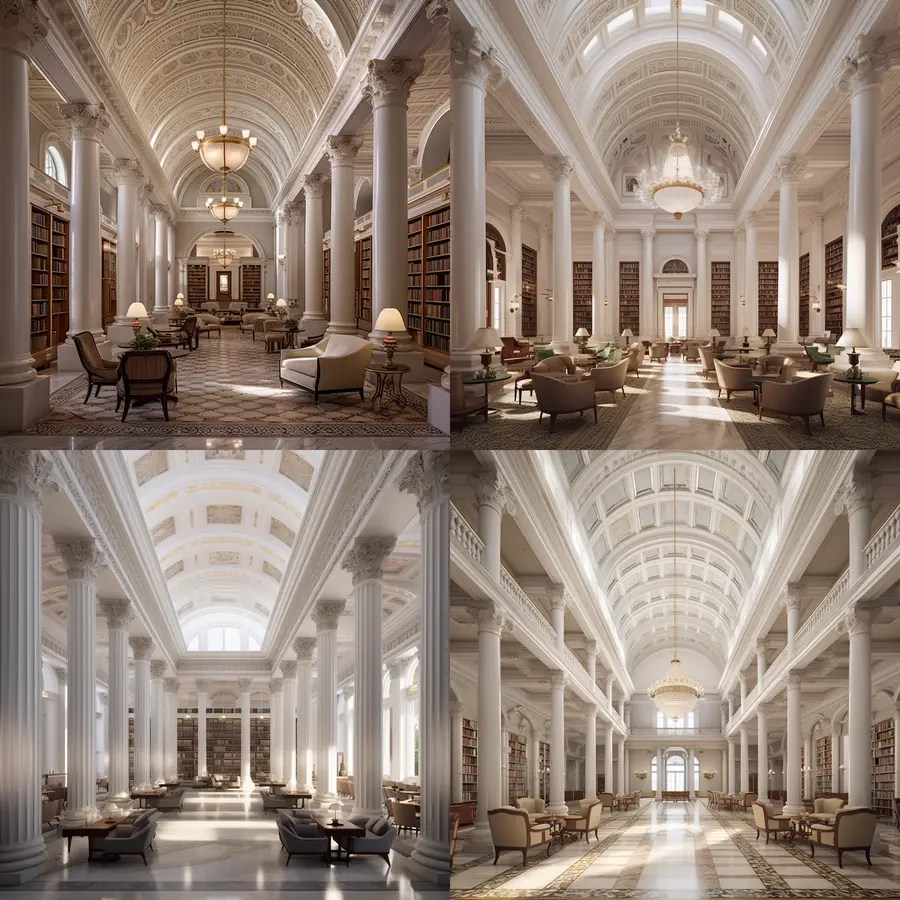
/imagine: a serene Neoclassical library, filled with rows of marble columns, symmetrical layouts, and grand reading rooms. The facade features a large portico, while the interior is illuminated by natural light filtering through the dome.
Famous architects to incorporate in your Midjourney prompts
From the towering pyramids of Giza to the steel-and-glass skyscrapers that pierce our contemporary skylines, architecture stands as a testament to human creativity and ambition. At the heart of these monumental achievements are architects—visionaries who have shaped and reshaped our built environment, each leaving an indelible mark on architectural history.
Understanding their styles, influences, and iconic works can be invaluable when crafting prompts for Midjourney. By referencing these architects, you can guide the AI towards generating designs that reflect their unique visions or blend their styles for novel creations.
Here are some of the world’s most influential architects whose work has pushed the boundaries of architectural design:
- I. M. Pei: Known for his modern designs, including the glass pyramid at the Louvre in Paris.
- Frank Lloyd Wright: An innovator of American architecture known for Fallingwater and the Guggenheim Museum in New York City.
- Zaha Hadid: Recognized as a major figure in architecture of the late 20th and early 21st centuries, particularly for her highly expressive designs that invoke the chaos of modern life.
- Le Corbusier: A pioneer of modern architecture and urban planning.
- Ludwig Mies van der Rohe: Known for his minimalist style and famous maxim “less is more”.
- Antoni Gaudí: A master of Catalan Modernism, his unique style blends Gothic and curvilinear Art Nouveau forms.
- Rem Koolhaas: Renowned for his provocative and unconventional designs, including the CCTV Headquarters in Beijing.
- Louis Sullivan: Often referred to as the “father of skyscrapers” and creator of the iconic phrase “form follows function”.
- Norman Foster: His high-tech architecture is characterized by sleek, modern designs using steel and glass.
- Frank Gehry: Famous for his deconstructivist architecture, including the Walt Disney Concert Hall and the Guggenheim Museum in Bilbao.
Whether you’re a professional architect or a creative enthusiast, drawing inspiration from these masters can help shape the direction of your architectural projects. Use their designs as a springboard for your own imagination, and let Midjourney AI bring those ideas to life.
Midjourney prompt examples incorporating famous architects
/imagine: a cityscape with buildings inspired by Zaha Hadid’s fluid and dynamic designs. Think of flowing lines, undulating forms, and a harmonious blend of architecture and landscape.

/imagine: a mountain retreat house, borrowing elements from Frank Lloyd Wright’s Prairie style. Emphasise horizontal lines, overhanging eaves, and a strong connection with the surrounding nature.

/imagine: a concert hall based on the style of Frank Gehry. Focus on the deconstructivist aesthetic, with its free-form curvilinear shapes, intricate angles, and shiny metal surfaces.

These prompts use the architects’ distinctive styles to guide Midjourney AI in creating images.
Conclusion
As we reach the end of our journey into the fascinating world of architectural design with Midjourney, it’s clear that the power to create breathtaking architectural visuals is now at our fingertips. The versatility of this tool is indeed awe-inspiring, yet its true potential lies in the hands of its user: you.
We’ve explored an array of architectural terminologies, dipped our toes into the wide ocean of architectural styles, and taken inspiration from some of the greatest architects who ever lived. But remember, these are not standalone elements. They are individual colors on your palette, awaiting your creative touch to blend, juxtapose, and harmonize in infinite combinations.
The prompts you craft for Midjourney are not just instructions to an AI; they are the language of your architectural vision, as unique and individual as a fingerprint.
Whether you wish to craft a modernist skyscraper with cantilevered balconies, create a Victorian mansion adorned with intricate friezes, or imagine a sustainable living space with lush green patios, the possibilities are limitless.
You can draw inspiration from the styles of Frank Lloyd Wright or Zaha Hadid, integrate elements of Gothic arches or Neoclassical columns, and invent designs that no one has ever seen before.
As you embark on your journey with Midjourney, never hesitate to experiment, explore, and make bold choices. Every architect was once a child who dared to build castles in the sky. Now, with Midjourney, the sky is no longer a limit, but a canvas. Here’s to the endless architectural wonders that await you in this groundbreaking merger of technology and creativity.