
Welcome back to another exciting edition of our “Midjourney Prompt of the Week” series! This week, we’re taking a thrilling detour into the world of anime. Whether you’re a seasoned otaku or a casual fan looking to explore new creative avenues, this week’s post is bound to spark your imagination.
As you know, Midjourney is more than a text to image generator – it’s a playground for creatives, a laboratory for visual storytelling, and a tool that can transcend language barriers and bring ideas to life. The fascinating thing about this tool is its adaptability, mirroring the artistic style of a vast array of artists. This week, we’ll harness the visual vibrancy, emotion, and complexity of anime.
What terminology to enthuse into your Midjourney anime prompts
In this article, we’ll list renowned anime artists, and directors and demonstrate how to integrate these into our own Midjourney prompts. With names like Hayao Miyazaki, Makoto Shinkai, and Masashi Kishimoto leading our list, we’re in for a visual feast.
But that’s not all! We’ll also delve into the process of creating Midjourney prompts that breathe life into these styles, resulting in stunning anime images that tell a story, evoke emotions, and capture the vibrant essence of anime.
Whether your preference lies in the magical realism of Studio Ghibli, the psychological drama of Satoshi Kon, or the action-packed adventures of Eiichiro Oda, we’ve got you covered.
So, keep reading because we’re about to embark on an exhilarating journey into the heart of anime, powered by the magic of Midjourney!
IMPORTANT! Turn on Niji before you start prompting for anime images
Before you begin crafting prompts, it’s essential to enable Niji Mode in your Midjourney settings. Niji Mode is a dedicated anime-specific model that comes loaded with extensive understanding of anime, its diverse styles, and aesthetics. To activate this feature, simply type ‘/settings’ and then choose Niji Version 5. While Version 4 is impressive in its own right, Version 5 takes the cake with its superior precision in capturing minute details and accurately portraying light refraction.


Famous anime artists to incorporate into your prompts
Here’s a collection of influential anime artists who have left their mark on the anime world. Experiment and infuse your prompts with these iconic names:
- Hayao Miyazaki – Co-founder of the renowned Studio Ghibli. Some of his notable works include “Spirited Away,” “Princess Mononoke,” and “My Neighbor Totoro.”
- Isao Takahata – Also a co-founder of Studio Ghibli, known for works such as “Grave of the Fireflies” and “The Tale of The Princess Kaguya.”
- Mamoru Hosoda – Known for his unique style and touching narratives. Some of his works include “Summer Wars,” “Wolf Children,” and “The Boy and the Beast.”
- Makoto Shinkai – Recognized for his visually stunning works. He is famous for “Your Name,” “5 Centimeters Per Second,” and “Weathering with You.”
- Satoshi Kon – Known for his psychological-thriller anime films. Some of his works include “Perfect Blue,” “Millennium Actress,” and “Paprika.”
- Osamu Tezuka – Often considered the father of modern anime and manga. He created the iconic series “Astro Boy.”
- Katsuhiro Otomo – Best known for “Akira,” a seminal work in the cyberpunk genre.
- Hideaki Anno – The creator of the influential series “Neon Genesis Evangelion.”
- Masashi Kishimoto – The creator of one of the most successful anime and manga series, “Naruto.”
- Eiichiro Oda – The creator of “One Piece,” which is recognized as the best-selling manga series of all time.
Please note that some of these artists primarily work in the field of manga (Japanese comic books), but their work has often been adapted into anime.
Prompt example:
/imagine: a young woman holding a sword defending herself from a dragon attack, by Hayao Miyazaki –ar 3:4 –niji 5

Anime Styles to infuse into your Midjourney prompts
In addition to integrating renowned artists into your Midjourney prompts, you might also consider infusing the various styles detailed below. Feel free to experiment by combining these styles in different ways until you achieve the desired results.
- Shōnen Style – This is perhaps the most widely recognized anime style, associated with series aimed at young boys. It’s characterized by high-action sequences, vibrant colors, and often features themes of friendship and adventure. Examples include “Naruto,” “Dragon Ball Z,” and “One Piece.”
- Shōjo Style – Targeted at young girls, this style is recognized for its focus on relationships and emotions. It often features soft color palettes, detailed backgrounds, and characters with large, expressive eyes. Examples include “Sailor Moon,” “Cardcaptor Sakura,” and “Fruits Basket.”
- Seinen Style – This style is targeted towards young adult and adult males. It often contains more mature themes, complex storylines, and can range from realistic to highly stylized art. Examples include “Ghost in the Shell,” “Berserk,” and “Psycho-Pass.”
- Josei Style – Josei anime targets adult females and tends to have more realistic romance and life situations. The art style can vary greatly but often leans towards a more mature and refined aesthetic. Examples include “Honey and Clover,” “Nodame Cantabile,” and “Chihayafuru.”
- Mecha Style – This style revolves around robots and futuristic themes. The art is often highly detailed, especially when it comes to the design of the mecha themselves. Examples include “Gundam,” “Neon Genesis Evangelion,” and “Code Geass.”
- Kodomo Style – This style is intended for young children and often features simple storylines, bright colors, and exaggerated character designs. Examples include “Doraemon,” “Pokémon,” and “Anpanman.”
- Gekiga Style – Gekiga is a more dramatic and mature style, both in terms of storyline and art. It’s not uncommon for the art in these series to have a more realistic feel. Examples include “Lone Wolf and Cub” and “Akira.”
- Chibi Style – Known for its cute, exaggerated features, especially big heads and small bodies, often used to depict humorous or overly cute moments.
Remember that these categories can overlap, and many anime series blend elements from different styles.
Prompt example:
/imagine: a woman in leather looks into the eyes of a young man, they stand in a rainy city street, in Seinen Style –ar 16:9 –niji 5

Anime directors for backdrop inspiration
Here are some directors that you can incorporate into your prompts. Note that several of the previously mentioned artists also function as directors, so it’ll require some experimentation to discern what yields the best results. However, infusing these names into your prompts might assist in enhancing the backdrop of your scenes.
- Mamoru Oshii – Known for his philosophical storytelling as seen in “Ghost in the Shell” and “Angel’s Egg.”
- Yoshiaki Kawajiri – Noted for his work on darker themed anime, including “Ninja Scroll” and “Wicked City.”
- Akiyuki Shinbo – Known for his distinctive visual style in series like “Puella Magi Madoka Magica” and “Monogatari Series.”
- Naoko Yamada – Acclaimed female director known for works like “K-On!” and “A Silent Voice.”
These directors have each brought unique styles and storytelling techniques to anime, creating a rich and diverse tapestry of works within the genre.
Prompt example:
/imagine: a woman in pink holds a champaign bottle in a night club, background in the style of Yoshiaki Kawajiri –ar 3:5 –niji 5

Character concept sheets and design
If you aim to bring uniformity to your character designs and poses, consider infusing your prompts with some of this terminology. Starting your prompts with these terms could make a world of difference in your experimentation process.
- Character Sheet: Also known as a character board, model sheet, or character study. It’s a document that illustrates the details of a character’s design from multiple angles and expressions.
- Silhouette: The outline of a character that is filled in with solid color (usually black). It’s used to test the readability of a character’s design.
- Line of Action: A line drawn through a character’s body to express motion or a posture. This is a fundamental concept for creating dynamic poses.
- Anatomy: The structural basis of a character, understanding of which is necessary for creating convincing characters.
- Proportion: The relative size and scale of the various elements in a design.
- Color Palette: The set of colors chosen for a character’s design. The color palette can convey a character’s personality and the overall tone or mood of a piece.
- Turnaround sheet: A sequence of images that shows the character from all relevant angles – typically front, side, and back.
- Expression Sheet: A collection of a character’s facial expressions, demonstrating their range of emotions.
- Pose Sheet: A series of sketches showing a character in different poses that reflect their personality.
- Stylization: A method of representing a character in an artistic and non-realistic fashion, but still making it identifiable.
- Foreshortening: A technique used in perspective to create the illusion of an object receding strongly into the distance or background.
- Thumbnail Sketch: A small, quick sketch used to test out different ideas and compositions.
- Secondary Action: An additional action that supports the main action to add more dimension to the character animation.
- Costume Design: The selection and coordination of clothing, accessories, and props used to convey a character’s personality and role.
Prompt examples:
/imagine: gothic girl, multiple angle character reference sheet, by Hideaki Anno –niji 5
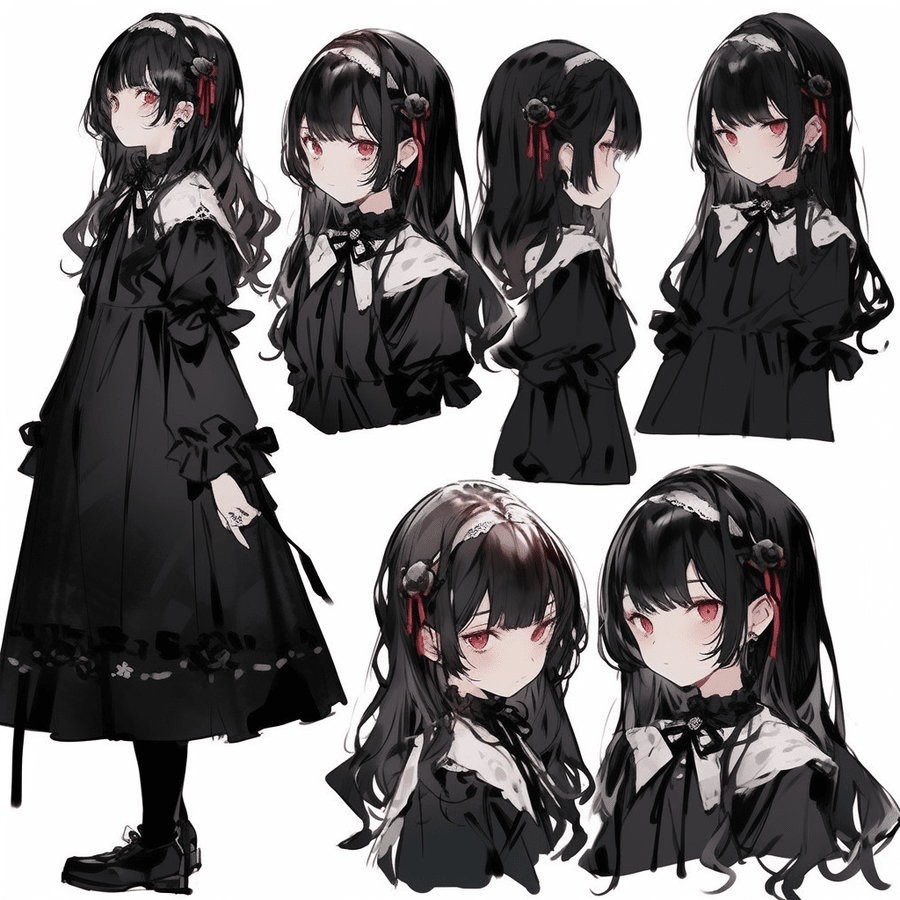
/imagine: gothic girl holding a teddy bear on white background, character reference sheet, in the style of Hideaki Anno –ar 4:6 –niji 5

Wrap up
In the vast landscape of visual storytelling, the ability to craft images that are true to the vibrant and multifaceted world of anime is an achievement in itself. The beauty of using Midjourney prompts lies in the possibilities it presents for your creative pursuits. The scope extends beyond integrating famous artists, anime styles, and the aesthetics of acclaimed directors into your work.
Don’t limit yourself. Anime, like any other artistic genre, is an amalgamation of influences, styles, and time periods. Try going a step further by including elements such as retro years, various styles of clothing, and props into your prompts. By doing so, you’ll not only enhance your Midjourney prompts but also add another layer of authenticity to your creations. Are you interested in the nostalgic feel of 80s anime? Or do you want to incorporate Victorian clothing into your character designs? There’s no limit to what you can explore and integrate!
With every experiment you undertake, remember to have fun and learn. The more you play with these elements, the more your understanding and skill will develop, enriching your journey as a Midjourney enthusiast.
In conclusion, the power of anime lies in its ability to transcend boundaries, blending art, culture, and storytelling into one vibrant tapestry. With Midjourney, you’re not just generating images – you’re creating, you’re exploring, and you’re telling a story. The world of anime is your oyster, and the possibilities are endless.
Feel free to share some of your fascinating discoveries in the comments below. Every unique integration of styles, props, or even a particular era, brings something new to the table, and we’d love to see what you come up with! Until next time, keep exploring, keep creating, and most importantly, enjoy the journey.