
As a web developer and AI enthusiast, I’ve long admired the powerful functionality of ChatGPT, a language model developed by OpenAI. Its capabilities to generate human-like text and engage in compelling conversations are truly remarkable. However, I understand that not everyone has the resources to access GPT-4, the engine that powers this incredible chat-bot. In the spirit of inclusivity and accessibility, I have made it my mission to explore alternatives that provide similar functionality without breaking the bank. This blog post is dedicated to all those intrigued by the magic of AI but are looking for more budget-friendly alternatives to ChatGPT. Let’s dive into this exciting world and see what other treasures it holds!
Bard by Google
Google’s entry into the world of AI chat-bots has been much anticipated following the popularity of ChatGPT. Initially, the tech giant remained cautious, wary of the possible misuse of its artificial intelligence technology in this space. However, Google has recently lifted the veil on its cutting-edge conversational AI service, known as Bard.
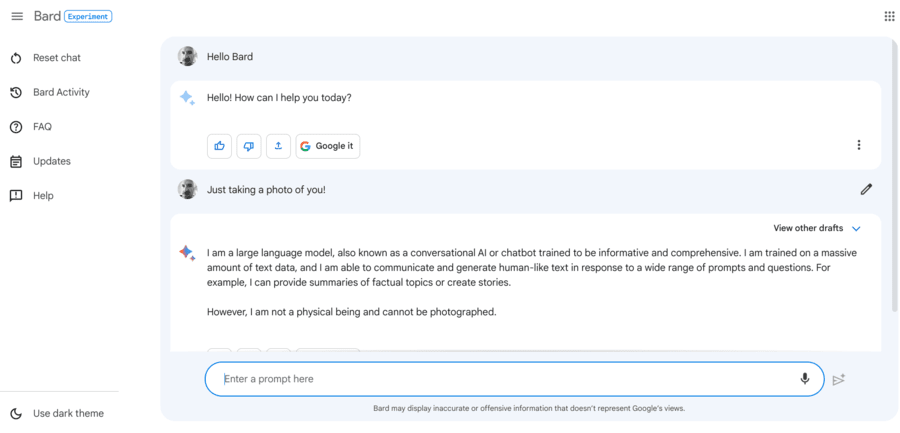
Google Bard, leverages the power of Google’s state-of-the-art PaLM 2 LLM technology. This advanced language and conversational model is the cornerstone of the company’s new-generation AI system.
Initially, Google’s Bard was restricted to a select few users. But now, the service is accessible to everyone, anytime. Google is pushing the envelope by introducing generative AI into its search capabilities, promising a significant transformation. The near future will see swift responses to queries appearing at the top of search results.
Advantages and disadvantages
Pros:
Quick response time
Cons:
Past issues of content duplication from websites
Doesn’t cite sources
Bard can code but not at the same level as ChatGPT
Microsoft’s Bing
A leading contender in the world of AI chatbot alternatives is Microsoft’s Bing AI. This reimagined search engine utilizes a refined version of ChatGPT, initially introduced as the “Prometheus model,” later revealed to be powered by GPT-4.
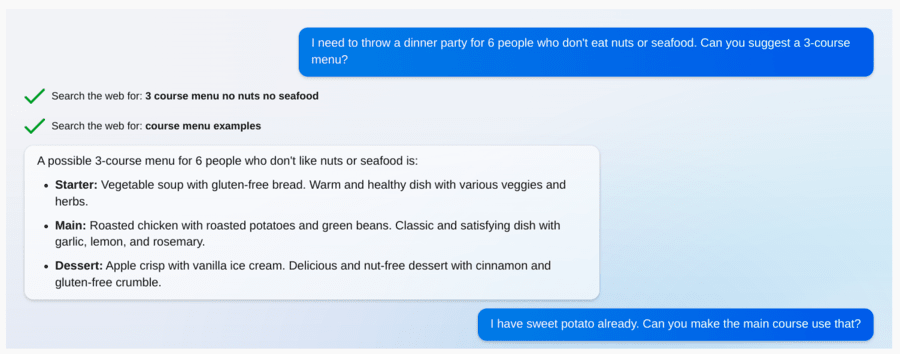
Interactive Bing – The new age ChatGPT
The updated Bing search engine incorporates an interactive Chat mode. This feature retrieves web queries, facilitating users to ask for relevant, contextual data based on these inquiries. This innovative AI assistant come search engine has been enriched with a plethora of new functionalities recently.
These include visually enhanced responses, improved accuracy, and the Bing Image Creator. Bing even assists users in planning trips, procuring recipes, seeking advice, and much more, akin to ChatGPT. While it was previously accessible only via a waitlist, this impressive ChatGPT alternative is now universally available.
Strengths and weaknesses
Pros:
Offers various conversation modes
Provides precise information
Acknowledges sources
Cons:
Response speed could be improved
Pi – Your Personal AI Companion
Among the various alternatives to ChatGPT, Pi offers a unique user experience that sets it apart. Envisioned as an intelligent and supportive AI, Pi is a chatbot with a distinctive design approach.
Rather than engaging in extensive chats, Pi carries out conversations in a dialogue-by-dialogue fashion. Adding an extra layer of intrigue, Pi is one of the few assistants that can converse back. With four remarkably realistic and soothing voice options available on the website, the interaction feels uncannily human-like.
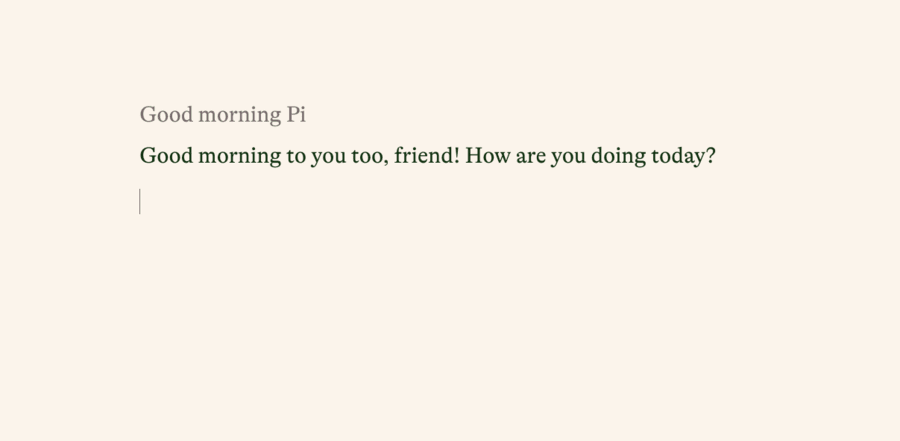
Distinct features of Pi as a ChatGPT alternative
One unique feature of Pi is that it initiates conversations on its own and attempts to gather as much information as possible from every message you send. Similar to a therapist, this alternative to ChatGPT is quite curious and seeks to provide comfort to the user. While this could become monotonous if you engage in continuous conversation, Pi is still considered one of the best ChatGPT alternatives available.
However, it is important to note that to sign up for Pi, you need an account and a valid phone number, which could be a barrier for some. Still, it’s worth giving it a try.
Advantages and drawbacks
Pros:
Exceptionally effective in mental health dialogues
Offers a realistic and soothing voice
Cons:
It can’t code like the previous models mentioned. Which maybe a con if you are using ChatGPT for development.
Requires a phone number for registration
ChatSonic: AI innovation by Writesonic
Developed by Writesonic, ChatSonic is an AI-powered chat-bot touted as the ‘gold standard’ of the AI chat-bot world.
While this might seem an audacious claim amidst the fame of AI chatbots like Google Bard and OpenAI’s ChatGPT, ChatSonic sets itself apart by addressing the shortcomings of ChatGPT. At the same time ChatSonic is powered by GPT-4 so you get to experience of those capabilities.
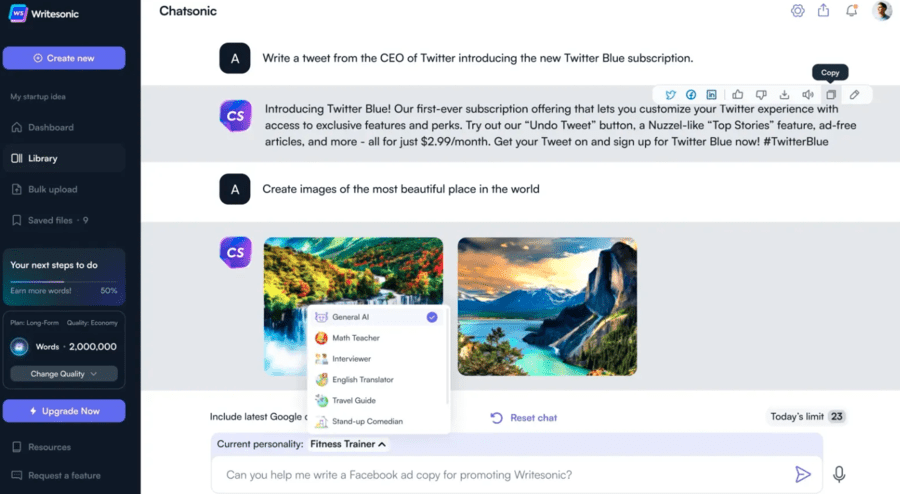
Interestingly, ChatSonic and ChatGPT bear more resemblances than one might expect. Both utilise OpenAI’s cutting-edge GPT-4 model and harness the power of natural language processing and machine learning to produce text responses.
Additionally, ChatSonic understands voice searches and is capable of creating AI-generated artwork. Writesonic has even incorporated an adjustable persona feature into their chat-bot.
You can customise your ChatSonic bot to function in various roles, including Relationship Coach, Interviewer, Travel Guide, and more.
ChatSonic is ideal for those seeking a robust ChatGPT alternative bolstered with a suite of AI writing tools. It enhances the capabilities of ChatGPT across a range of uses. If your work involves professional writing such as blog posts, articles, or technical documents, you’ll find ChatSonic highly beneficial.
Strengths and weaknesses
Pros:
Powered by GPT-4
Internet connectivity enables a wealth of knowledge
Variety in conversations due to different personas
Companion browser extension and Android app available
Can read responses aloud
Cons:
Limited to only 25 free text generations or
10,000 free words
OpenAI Playground
The OpenAI playground serves as an accessible alternative to ChatGPT, functioning much like a sample version of the same. OpenAI presents GPT3 along with other models for users to readily test various applications. You will need to credit an OpenAI account to use this, but the costs are really low. Just see how you get on.
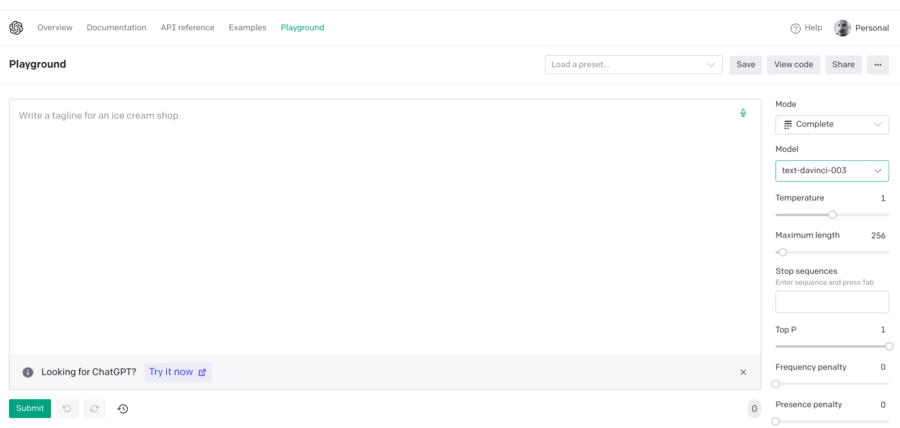
While the OpenAI playground is not necessarily designed for the average user, it offers an excellent opportunity for those unable to access ChatGPT to experience its sophisticated features. Similar to ChatGPT, the OpenAI playground facilitates user experimentation with diverse language models online.
Users should note the technical nature of the Playground, given its range of adjustable parameters like temperature, frequency penalty, number of tokens, stop sequences, and so forth.
Key Features of OpenAI playground
Here are some noteworthy attributes of the OpenAI Playground:
- Exceptional accuracy and speed.
- A variety of language models to select from.
- High flexibility facilitating easy experimentation.
- Advantages and Limitations
Pros:
An array of language learning models to choose from
Accuracy and response speed comparable to ChatGPT
Cons:
Not designed for everyday use
Does cost money for each query, but these costs are pennies in most cases.
StableLM by Stability AI
Stability AI is a noteworthy contender in the AI realm, providing a robust challenge to OpenAI. Although its crowning achievement has been the Stable Diffusion AI image generator, it has recently launched an open-source language learning model (LLM) known as StableLM. It’s available for a trial run on Hugging Face, an AI community website that hosts a free Alpha test of StableLM accessible to all.
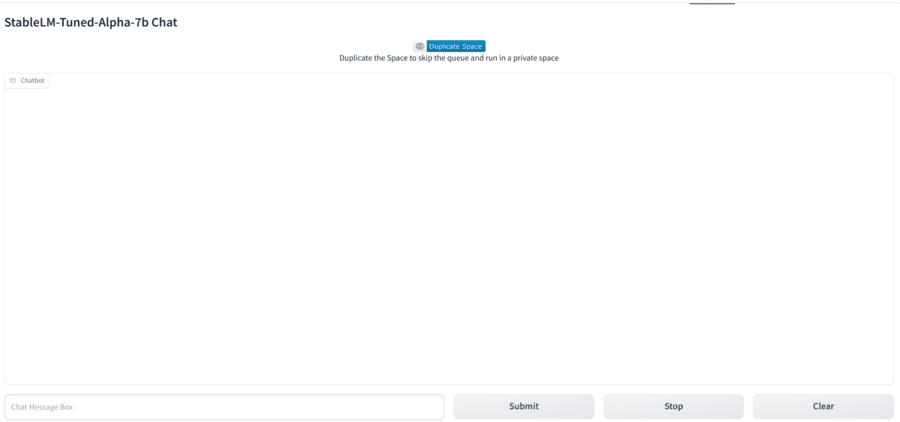
However, StableLM does have certain drawbacks when compared to ChatGPT. It’s not trained on the same volume of data as ChatGPT, being trained only on 3 billion to 7 billion parameters as opposed to OpenAI’s 175 billion-parameter GPT-4 model. Additionally, StableLM lacks the reinforcement training that continually refines ChatGPT, typically implemented through user feedback on whether the chatbot delivered the expected response.
Despite these challenges, StableLM proves effective. I tested it by having it devise a content strategy for a bustling financial website. While it wasn’t flawless and its speed was noticeably slower than ChatGPT’s, its performance was commendable nonetheless.
In all likelihood, StableLM will emerge as a ChatGPT alternative to keep an eye on in the future. However, it’s definitely worth giving a try in the present as well.
Strengths and limitations
Pros:
Accessible to everyone free of charge
Produces impressive results
Cons:
Trained on a lesser quantity of data compared to ChatGPT
More likely to “hallucinate” or produce irrelevant responses than ChatGPT
Conclusion
The realm of AI chatbots is expanding and evolving at a rapid pace. While ChatGPT has paved the way with its robust functionalities, a multitude of compelling alternatives are making a splash in the AI universe.
From Google’s Bard to Stability AI’s StableLM, each alternative brings unique attributes to the table. The aforementioned alternatives are not only powerful but also, in many cases, more accessible. They ensure that the magic of AI is not confined to a privileged few but reaches a broader audience. As an AI enthusiast, it’s incredibly exciting to witness this evolution. I believe the insights presented here will guide you in finding the most suitable ChatGPT alternative that aligns with your needs and resources.
We are here to help you
Frequently asked questions
Find the answers you are looking for…
Why look for ChatGPT alternatives?
While ChatGPT is a remarkable AI model, its access may be cost-prohibitive for some users. Also, different models offer unique functionalities that might be better suited to specific needs.
Are these alternatives as powerful as ChatGPT?
While they might not match ChatGPT in terms of the sheer amount of training data, these alternatives do bring significant capabilities to the table. Each has unique strengths that can be beneficial for various use cases.
Can I use these alternatives for free?
Some alternatives like StableLM offer free access. However, it’s important to review each platform’s pricing structure, as some might have limited free usage or require paid subscriptions for full functionality.
Which alternative is best for professional writing tasks?
ChatSonic is a great alternative for professional writing tasks. It comes with a suite of AI writing tools that can generate blog posts, articles, and technical documents.
Which alternative is the most user-friendly?
Pi offers a unique and user-friendly approach to AI chats. It initiates conversations and tries to make them as engaging and supportive as possible. However, what’s “user-friendly” can vary from person to person based on individual needs and preferences.