
In the age of Midjourney, the boundary between reality and digital creation often blurs, especially in the world of visual arts. One particularly intriguing frontier is generating nature photography images purely from textual prompts. But how does one craft the perfect Midjourney prompt to evoke a serene lakeside sunset or a bustling, vibrant forest? Just as in traditional photography where the right settings make all the difference, the art of “writing” your image is crucial in this digital realm.
In this article, we explore the art and science of constructing Midjourney nature prompts. From the specificity of descriptions and the nuances of lighting to even emulating the perspectives of popular camera models and lenses, we’ll guide you through techniques that can elevate your Midjourney results. To get you started, we’ll also share seven meticulously crafted prompts that incorporate these tips, designed to produce stunning nature images.
Tips for crafting nature photography prompts in Midjourney
Crafting prompts for Midjourney, especially for generating nature photography images, requires clarity, specificity, and sometimes creativity. Here are some tips to optimize your prompts:
Be specific with descriptions:
- Instead of “forest,” specify “dense pine forest at dawn.”
- Instead of “waterfall,” write “cascading waterfall with mist surrounding it.”
Time of day:
Mention the time of day to influence the lighting in the generated image, e.g., “sunset,” “midday,” or “golden hour.”
Weather conditions:
Describe the desired weather conditions, such as “cloudy,” “rainy,” “foggy morning,” or “clear starry night.”
Foreground, mid-ground, background:
Dividing the scene into these three layers can help the AI better generate a detailed image. For instance, “Foreground with vibrant wildflowers, mid-ground with a calm lake, and a background with a towering snow-capped mountain.”
Animal inclusion:
If you want to include wildlife, be precise. Instead of “birds,” specify “a flock of flamingos taking flight.”
Camera and lenses:
Mention the desired “perspective” or “focal length” to influence the composition, such as “wide-angle view” or “telephoto perspective.”
For added specificity, you can name real-world camera models and lenses. For more information on camera models and lenses I found the following website useful https://www.naturettl.com/best-camera-wildlife-photography. The following short list is for models I know that Midjourney recognises:
- Cameras: Canon EOS 5D Mark IV, Nikon D850, Sony A7R IV, and Canon EOS R5.
- Lenses: Canon EF 16-35mm f/2.8L III USM, Nikon AF-S NIKKOR 70-200mm f/2.8E FL ED VR, and Sony FE 100-400mm f/4.5-5.6 GM OSS.
Texture and detail:
Add words that describe the texture or detail you want to see, like “glistening,” “rough,” “smooth,” or “reflective.”
Emotions or themes:
Sometimes, evoking a certain mood can be beneficial. Words like “tranquil,” “mystical,” “dramatic,” or “serene” can set a tone for the image.
Include human elements sparingly:
Unless necessary, avoid adding human elements to maintain the natural essence. If you must, be specific, e.g., “a lone hiker in the distance.”
Experiment and iterate:
AI models can interpret prompts in various ways. Don’t be afraid to tweak your prompts and try different phrasings to get the desired result.
Remember, while including camera models and lens types can give Midjourney a clearer picture of the type of image you’re trying to emulate, Midjourney doesn’t have a “real” camera. The mention is merely a way to help it better understand the perspective, depth of field, and other stylistic choices common with those tools.
Some example prompts designed to emulate nature photography
Misty mountain morning
/imagine: a golden hour view of a dense pine forest in the foreground, leading to a calm, reflective lake in the midground, and tall mountains shrouded in mist at the background. Use a Canon EOS 5D Mark IV perspective with a Canon EF 16-35mm f/2.8L III USM wide-angle lens –ar 16:9

Wildlife at dusk
/imagine: a serene African savannah at dusk, lit with soft orange hues. In the foreground, a pride of lions lounging, while in the distance, an acacia tree stands tall against a dramatic sunset. Use a Sony FE 100-400mm f/4.5-5.6 GM OSS telephoto perspective –ar 16:9

Ocean’s embrace
/imagine: A tranquil and glistening beach scene during the golden hour. Foreground with smooth wet sand reflecting the sky, midground with gentle waves kissing the shore, and background with a vibrant horizon where the sun meets the ocean. Nikon D850 viewpoint with Nikon AF-S NIKKOR 70-200mm f/2.8E FL ED VR lens, –ar 16:9

Desert night sky
/imagine: a clear starry night over a vast desert landscape. In the foreground, rough-textured sand dunes with patterns from the wind, while the Milky Way stretches brilliantly across the midnight sky in the background. Canon EOS R5 perspective with a wide-angle view –ar 16:9

Enchanted forest
/imagine: a mystical old forest during a foggy morning. Foreground with dew-covered spider webs, mid-ground with ancient trees cloaked in moss, and a background of light rays piercing through the mist. Use a Sony A7R IV perspective with a wide-angle lens –ar 16:9

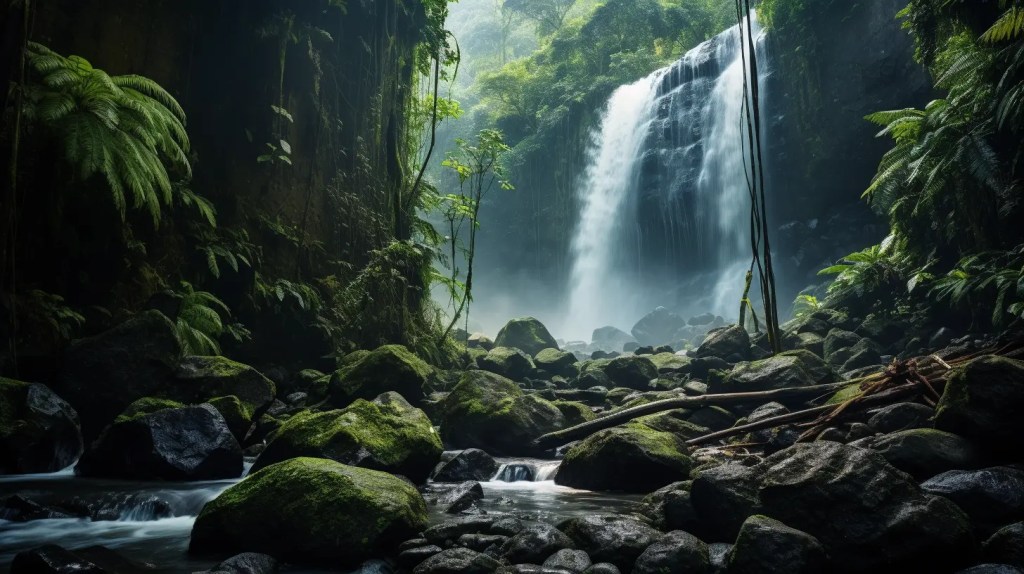
Waterfall majesty
/imagine: a dramatic cascading waterfall surrounded by lush greenery. Foreground with shimmering rocks and moss, midground with the powerful waterfall creating a mist, and a background of a dense tropical jungle. Viewpoint of a Canon EOS 5D Mark IV with Canon EF 16-35mm f/2.8L III USM lens –ar 16:9
Frozen wilderness
/imagine: a serene snowy landscape at twilight. Foreground with fresh snow tracks of wild animals, midground with a frozen, reflective lake, and in the background, towering snow-capped mountains under a purplish-blue sky. Nikon D850 perspective with a telephoto lens –ar 16:9

These prompts combine various techniques mentioned, such as specificity, layering of scenes, mood evocation, and camera/lens emulation.
Conclusion
In the seamless blend of words and visuals, the art of crafting Midjourney prompts emerges as a groundbreaking tool for digital creation. By harnessing the power of specificity, emotion, and technical emulation, we can paint vivid natural landscapes, all from a few carefully chosen phrases. As we venture further into the digital age, may your textual canvas always reflect the beauty of nature you seek.