
Venturing into the realm of horror prompts within Midjourney, presents an intriguing yet challenging exercise. Unlike typical prompt crafting, generating frightful imagery in Midjourney faces certain limitations due to the conscious censorship applied to prevent graphic horror renderings. A predefined list of prohibited words stands as a barrier, limiting the conventional freedom of vocabulary selection for your prompts.
Despite these constraints, the creation of chilling and terrifying visuals remains entirely achievable. The capacity to weave uncanny scenarios and engender an atmosphere of dread within the confines of AI-induced restrictions makes this endeavour all the more thrilling and rewarding.
In this forthcoming exploration, we aim to equip you with the tools necessary for this task. We’ll delve into the works of renowned horror artists, introduce fitting terminology, and demonstrate potential examples of spine-chilling scenes that you can concoct in your prompts.
A noteworthy attribute of Midjourney is its inherent dark and Gothic aesthetic, which serves as a favourable ally in generating disconcerting or eerie images. As we venture deeper, you’ll discover how these elements can be harnessed to conjure a truly haunting spectacle. So prepare yourself for a fascinating journey into the cryptic world of text-to-image horror prompts with Midjourney.
/imagine: dark lit wall emphasised by long shadows, small other worldly creatures occupy the cracks. The all flows like an HR Giger set –ar 16:9
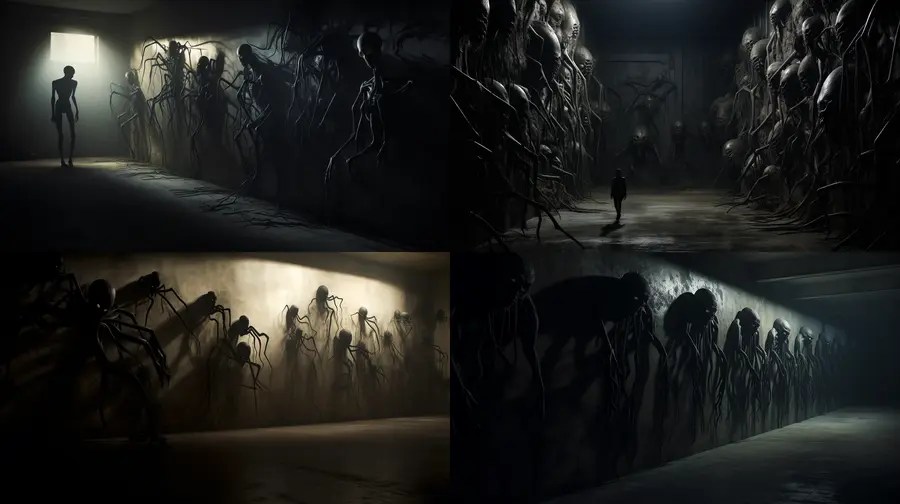
Famous contributors to the horror genre to include in your prompts
Here is a list of notable artists, from various mediums, who are famous for their work in the horror genre. You can see how I have incorporated some these famous names into the prompt examples above and below:
- H.R. Giger – Known for his work in designing the alien creature in Ridley Scott’s “Alien” series, his bio-mechanical art style is iconic in the world of horror.
- Stephen Gammell – An illustrator known for his eerie, surreal art in the “Scary Stories to Tell in the Dark” series of children’s books.
- Junji Ito – A renowned Japanese horror manga artist. His works such as “Uzumaki” and “Tomie” are known for their distinctive, unsettling art style.
- Bernie Wrightson – An American artist known for co-creating the Swamp Thing and his detailed horror-themed illustrations, particularly those for Mary Shelley’s “Frankenstein”.
- Edward Gorey – An American artist and writer known for his illustrated books. His work often depicts unsettling, gothic scenes.
- Charles Addams – An American cartoonist known for creating “The Addams Family”, whose macabre characters have become a fixture in popular culture.
- Mike Mignola – Comic book artist and writer famous for creating “Hellboy”, a series filled with supernatural and horror elements.
- Tim Burton – Filmmaker, artist, and writer known for his dark, gothic, and horror-filled works such as “Beetlejuice”, “Edward Scissorhands”, and “The Nightmare Before Christmas”.
- Francis Bacon – An Irish-born British figurative painter known for his raw, emotionally charged imagery. Though not a horror artist per se, many find his work deeply unsettling.
- Clive Barker – An English author, director, and visual artist known for his work in both horror and fantasy. He wrote and directed “Hellraiser”, and his grotesque art can be seen in his own books.
- Yoshitoshi ABe – A Japanese manga artist best known for his work in “Serial Experiments Lain” and “Haibane Renmei”. His art often has a dark, eerie feel.
Please note that some of these artists are not exclusively horror artists, but they have contributed significantly to the genre.
/imagine: a Clive Barker creature of the night holding a magical box, the atmosphere is gloomy and dark shadows contrast to small glimpses of light, unsplash, cinematic –ar 5:9

/imagine: a Tim Burton influenced character of a undead man in a pink polka dot suit, his grey matted hair falling in clumps, his lips dry and sore, cinematic, realistic

/imagine: some unsettling Edward Gorey characters

/imagine: a young woman in a dark doorway in the style of Yoshitoshi ABe –ar 16:9 –niji 5

Banned gore words in Midjourney
Formulating horror-themed prompts in Midjourney can be challenging due to their restrictions on the use of numerous graphic terminology that one might wish to include. The subsequent list encompasses a majority of these, although you may come across additional ones. Refrain from integrating them into your prompts.
- Blood
- Bloodbath
- Crucifixion
- Bloody
- Flesh
- Bruises
- Car crash
- Corpse
- Crucified
- Cutting
- Decapitate
- Infested
- Gruesome
- Kill (as in Kill la Kill)
- Infected
- Sadist
- Slaughter
- Teratoma
- Tryphophobia
- Wound
- Cronenberg
- Khorne
- Cannibal
- Cannibalism
- Visceral
- Guts
- Bloodshot
- Gory
- Killing
- Surgery
- Vivisection
- Massacre
- Hemoglobin
- Suicide
- Female Body Parts
Horror terminology to help with your prompts
/imagine: a foggy graveyard. A psychotic clown with a red ballon stands in the distance. The light glaring from its eyes. Cinematic, unsplash –ar 16:9 –v 5.2

Try incorporating some of the following to help set your horror prompt scenes:
- Shadowy Figure – The idea of an unknown entity lurking in the shadows can evoke a sense of fear.
- Eerie Silence – This suggests an unsettling quietness where there should be noise.
- Haunted House – A classic in horror, full of potential for frightening visuals.
- Gothic Architecture – Can set a grim, ominous atmosphere.
- Spectral Presence – Implies a ghostly figure.
- Grim Reaper – The personification of death can certainly add a horror aspect.
- Creepy Dolls – These can be depicted in an unsettling way.
- Full Moon – Often associated with werewolves and other supernatural creatures.
- Foggy Graveyard – Can be used to suggest an eerie and haunted place.
- Desolate Forest – Can be both beautiful and frightening, particularly in horror settings.
- Cryptic Symbols – Adds a sense of mystery and unease.
- Petrifying Nightmare – Gives an opportunity to illustrate the character’s deepest fears.
- Ravens or Crows – Often symbolic of omens or death in horror.
- Ancient Tombs – Can be eerie and suggest a history of horror.
- Blood Moon – Implies a supernatural or ominous event.
- Ghoulish Entity – A non-graphic way to suggest a scary creature or ghost.
- Ominous Fog – A classic horror setting, it obscures the unknown.
- Winding Staircase – Can suggest the idea of a journey into something frightening.
- Shrieking Wind – A classic auditory element in horror, but can also be visualized.
- Dilapidated Mansion – Suggests a long history and potential for hidden horrors.
/imagine: a dark Dilapidated Mansion a set of eyes can be seen from a dark and damp doorway. –v 5.2

/imagine: some creepy dolls sit in an old rocking chair in a attic that feels like it could be in a Clive Barker horror –ar 16:9 –v 5.2

Remember, the power of horror often lies in what is suggested or unknown rather than what is explicitly shown. A successful horror image might not be explicitly terrifying, but could suggest something lurking just out of view, or a situation that could quickly turn scary.
Using the ideas presented you now have the tools needed to go and create your own terrify and creepy Midjourney horror prompts and images. Enjoy!